10/2026
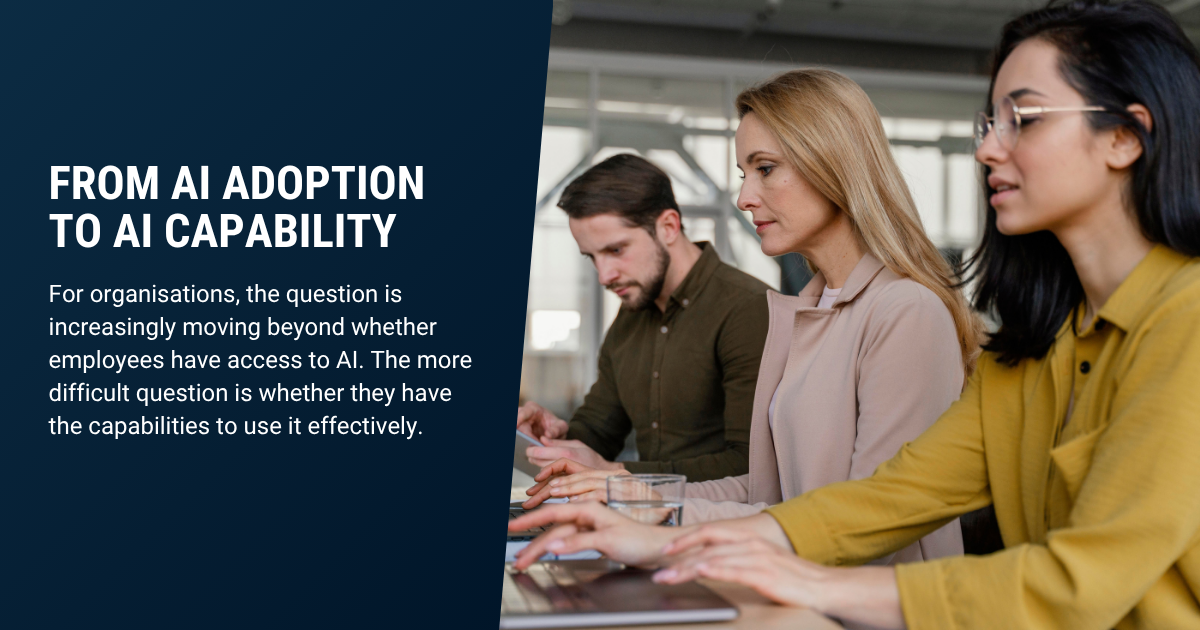
From AI Adoption to AI Capability
AI adoption in European companies is accelerating.
In 2025, 20% of EU enterprises with at least ten employees reported using AI technologies, compared with 13.5% in 2024 and 8.1% in 2023. Among large enterprises, adoption had already reached 55%. In Germany, the figure across enterprises stood at approximately 26% (Eurostat, 2026).
Those numbers tell us something important about the speed of adoption. But they tell us very little about capability.
A company can provide Microsoft Copilot, ChatGPT Enterprise or another AI system to thousands of employees and legitimately count itself among the organisations using AI. That does not tell us whether employees know where AI creates value in their work, whether they can evaluate its outputs, whether managers know how AI should change workflows, or whether people can use it responsibly without outsourcing their own judgement.
For organisations, the question is increasingly moving beyond whether employees have access to AI. The more difficult question is whether they have the capabilities to use it effectively.
AI adoption is moving faster than AI capability
The speed of technology uptake is striking. Across the EU, the proportion of enterprises using AI was roughly 2.5 times higher in 2025 than in 2023. Larger companies are moving particularly quickly: 55% reported using at least one AI technology in 2025, up from 30.5% only two years earlier (Eurostat, 2026).
Yet the OECD identifies skills shortages as one of the constraints on further AI diffusion. Its 2026 analysis also makes an important distinction: adapting to AI requires more than specialist AI expertise. Workers increasingly need a combination of foundational and digital skills alongside capabilities such as problem solving, autonomy, creative thinking, communication, collaboration and the ability to continue learning (OECD, 2026).
There are signs that development is not necessarily keeping pace.
An OECD survey of more than 5,000 SMEs across seven countries, including Germany and Austria, found that among SMEs already using generative AI, only 23.6% reported that their employees participated in AI-related training. The OECD also found that businesses whose employees participated in AI-related training were more likely to report positive outcomes from generative AI. The study concerns SMEs and is based on 2024 survey data, so it should not be generalised to large enterprises. But it illustrates the broader gap between making AI available and systematically preparing people to work with it (OECD, 2025).
For companies, this creates a second challenge after the technology has been introduced. Providing access is relatively straightforward. Developing the capabilities people need to integrate AI into their work, assess its outputs and use it productively is a much more substantial task. Without that development, growing adoption does not necessarily translate into better ways of working.
The real question is not whether employees “use AI”
Usage itself is a weak measure of maturity.
Someone who occasionally asks a chatbot to summarise a document is an AI user. So is someone who has redesigned a recurring workflow around AI, understands which tasks should and should not be delegated, checks outputs against appropriate evidence and knows when human judgement needs to override the system.
Those behaviours do not represent the same level or type of capability.
This distinction matters because generative AI dramatically lowers the barrier to producing an output. A plausible answer, analysis, presentation structure or recommendation can appear within seconds. The human task increasingly lies in knowing what to ask, what context the system needs, whether the result can be trusted and what should happen with it afterwards.
Employees need to recognise where AI can meaningfully improve a task or process and where it cannot. They need to decide what can be delegated and what should remain human, recognise plausible but incorrect outputs, understand how information can be used responsibly and know when verification, escalation or expert judgement is required.
The OECD's analysis of skills in the AI age supports this broader understanding of AI-era capability. It identifies not only ICT skills but complementary capabilities including teamwork, autonomy, problem solving, creative thinking, communication, collaboration and continuous learning as important in increasingly AI-exposed working environments (OECD, 2026).
Prompting is one element of working with generative AI, but it covers only a small part of what effective use demands. The more consequential capabilities lie in recognising where AI is useful in the first place, giving it the right context, evaluating what it produces and deciding what to do with the result. For organisations, the development challenge is therefore considerably broader than teaching employees how to interact with a chatbot.
The EU AI Act makes the capability question more concrete
The conversation around AI capability is no longer driven only by productivity ambitions. In Europe, organisations also have to consider what sufficient AI literacy looks like for the people who work with AI systems.
Article 4 of the EU AI Act has required providers and deployers of AI systems to take measures to ensure a sufficient level of AI literacy among relevant staff since February 2025. Importantly, the regulation does not define this as a standardised training requirement. The appropriate measures depend on factors including people's technical knowledge, experience, education and training, as well as the context in which an AI system is being used (European Commission, 2026).
That context matters. Someone using generative AI to draft internal communications is working with different risks and decisions than a manager using AI-supported information to prepare a business decision. An HR team working with an AI-enabled system operates in yet another context. A general introduction to AI may provide a common foundation, but it cannot address every capability requirement equally well.
This makes AI literacy a useful starting point for a broader L&D question: What does a particular group of employees actually need to know and be able to do to work effectively with AI in their role?
The European Commission's repository of AI literacy practices already includes examples of organisations combining general AI education with training adapted to particular roles, functions or levels of expertise. Rather than treating the workforce as a homogeneous group of “AI users”, this points towards development that reflects how AI is actually encountered at work (European Commission, 2026).
For HR and L&D, that shifts the task from delivering an AI course to defining relevant capabilities. A shared baseline may be appropriate across the organisation, while the behaviours and skills expected of different target groups can vary substantially.
AI capability is also a leadership question
AI adoption is often discussed as something the workforce needs to do: employees need to experiment more, learn new tools and become more productive.
But what happens when the people expected to steer this transformation have little practical understanding of how AI changes the work itself?
The OECD finds that managers and professionals are among the occupations most exposed to AI. At the same time, these roles tend to depend heavily on non-routine cognitive and social capabilities, making exposure to AI very different from straightforward automation risk (OECD, 2026).
Leaders do not necessarily need to become AI specialists. But they need enough practical understanding to make informed decisions about its use. They need to recognise where AI can remove friction and where it may lower quality, decide which workflows should change, establish appropriate guardrails and clarify where accountability remains explicitly human.
Leadership behaviour also shapes how employees approach new technology. Asking people to experiment with AI while existing processes, expectations and decision-making structures remain unchanged creates an obvious tension. Employees may find individual shortcuts and useful applications, but turning those experiments into better organisational practices requires decisions about workflows, roles, responsibilities and collaboration.
AI capability therefore cannot sit exclusively with individual employees or with L&D. It also affects how leaders design and manage work.
AI capability requires more than Digital Enablement
At DeepSkill, we understand Digital Enablement Skills as one part of a broader Business-Critical Skills architecture. They include the capabilities needed to use digital technologies and AI confidently and responsibly. But they interact with two other areas: Self Enablement Skills and Collaboration Enablement Skills.
That interaction becomes particularly visible with AI.
An employee may know how to operate an AI system but still lack the critical reflection needed to question an attractive answer. A manager may understand the technology but struggle to lead a team through changing responsibilities and uncertainty. A team may have strong individual AI users but no shared norms for when, where and how AI should be integrated into collaborative work.
Digital Enablement helps people understand AI, identify useful applications and use digital systems confidently and responsibly. Self Enablement becomes relevant when people need to reflect critically, learn and unlearn, deal with ambiguity and retain their own judgement. Collaboration Enablement matters when AI changes workflows, responsibilities, communication and leadership across teams.
These capabilities do not operate independently. AI changes not only the tools people use, but also how they make decisions, organise work, collaborate and learn. That is why treating AI capability as an isolated technical skillset captures only part of the development challenge.
From “AI for everyone” to capability by business context
For HR and L&D leaders, the practical consequence is not necessarily to create more AI courses. It is to become more precise about what people need to be able to do.
A useful starting point is the business context. Where should AI create value? Which processes, decisions or activities could meaningfully improve through its use?
From there, organisations can define the behaviours that need to change. “Use AI more” is too vague to guide development. A particular group might need to identify better use cases, validate outputs more systematically, redesign recurring workflows or make faster decisions while retaining accountability.
Only then does the skills question become concrete. Different target groups may require different combinations of AI knowledge, application capability, critical thinking, communication, self-leadership or change capability.
The learning architecture should reflect those differences and connect development with the situations in which people are expected to apply what they have learned. And measurement needs to look beyond activity indicators. License activation, logins and course completion can show whether a tool or learning offer is being used. They do not, by themselves, demonstrate that people have developed the capabilities required to work effectively with AI.
This is the logic behind DeepSkill's approach to Business-Critical Skills: starting with the organisational challenge and desired target behaviour, identifying the capabilities that matter for specific target groups, translating them into tailored learning journeys and measuring how those capabilities develop.
Moving beyond access
The first phase of enterprise generative AI was dominated by access: introducing tools, running pilots, creating policies and encouraging employees to experiment.
As adoption grows, the questions become more demanding.
Where does AI actually improve the work? Which capabilities allow employees to use it well? How do those requirements differ across roles? What needs to change in leadership and collaboration? And how can organisations tell whether their people are becoming more capable rather than simply more active users?
For HR and L&D, these questions expand the scope of AI enablement considerably. Technical understanding remains important, but so do judgement, learning capability, communication, leadership and the ability to translate a new technology into better ways of working.
Giving people access to AI may be increasingly commonplace. Building an organisation that knows what to do with it is a different task.
References
European Commission. (2026). AI literacy – Questions & answers. Shaping Europe’s Digital Future. https://digital-strategy.ec.europa.eu/en/faqs/ai-literacy-questions-answers
European Commission. (2026). Repository of AI literacy practices. Shaping Europe’s Digital Future. https://digital-strategy.ec.europa.eu/en/policies/ai-literacy-practices
Eurostat. (2026). The use of artificial intelligence technologies in the European Union – Key results – 2026 edition. Publications Office of the European Union. https://ec.europa.eu/eurostat/web/products-statistical-reports/w/ks-01-26-009
OECD. (2025). Generative AI and the SME workforce: New survey evidence. OECD Publishing. https://doi.org/10.1787/2d08b99d-en
OECD. (2026). Skills in the AI age. OECD Artificial Intelligence Papers, No. 60. OECD Publishing. https://doi.org/10.1787/972bd15e-en

Safeguard your organization's performance and retention during strategic transitions.
Let's discuss a customized roadmap for your team.