08/2026
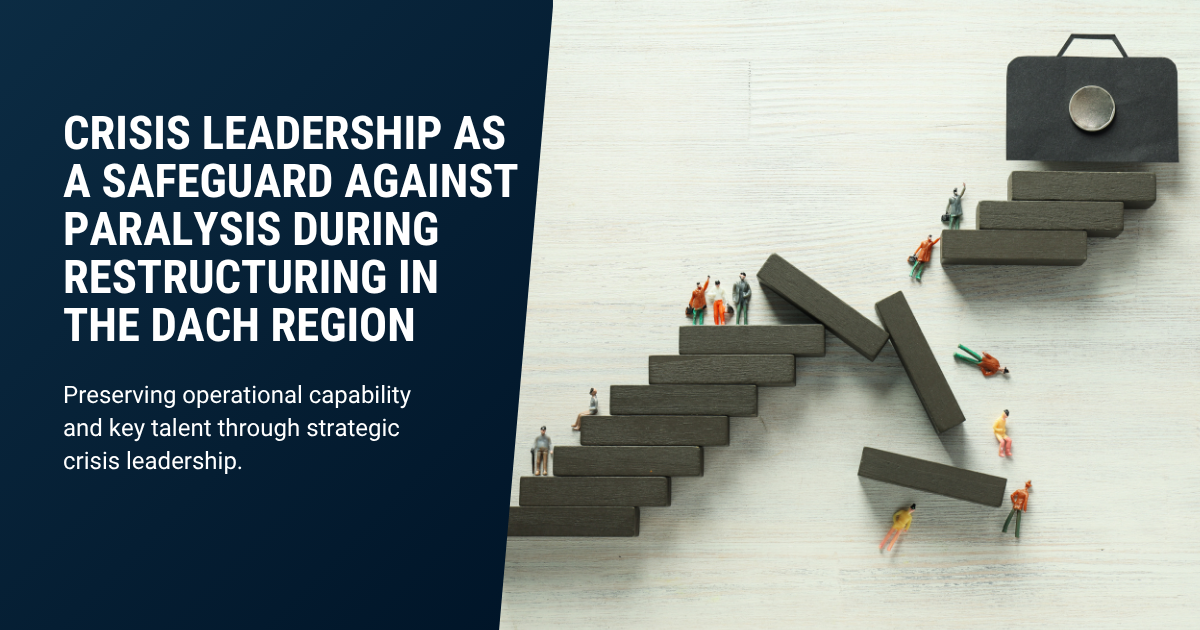
Crisis leadership as a safeguard against paralysis during restructuring in the DACH region
Economic headwinds and organizational restructuring place unprecedented strain on executive leadership and team morale. In high-pressure environments, strategic empathy and emotional self-regulation operate as the primary anchors for organizational stability and retention.
From economic analyses by the German Federal Ministry for Economic Affairs (BMWK) to strategic insights from McKinsey, experts agree that DACH organizations across manufacturing, technology, and corporate services face persistent economic headwinds, margin pressures, and operational realignments. During periods of corporate restructuring, executive instinct often defaults to transactional efficiency: cut budgets, streamline workflows, and tighten operational control.
However, relying on cold efficiency during high-stress transitions creates a hidden operational crisis. When uncertainty escalates, traditional top-down leadership breeds disengagement, decision paralysis, and the loss of critical talent. Empathy is not a soft "nice-to-have" reserved for prosperous growth phases; it is a core strategic mechanism that preserves organizational stability and performance during disruption.
The Operational Risk of "Cold Efficiency"
Restructuring efforts frequently fail to achieve their financial targets not because of flawed strategy, but due to human friction. When leaders pull back on human-centric communication and development during downturns, psychological safety collapses.
Employees who operate under acute uncertainty shift into survival mode. Risk aversion spikes, cross-departmental communication degrades, and decision-making slows to a crawl. As Harvard Business Review pointed out when analyzing leadership in crisis, managing uncertainty requires leading with clarity and human connection, because high performers are typically the first to disengage or exit when transparent communication gives way to top-down directives.
The Dual Pillars of Crisis Leadership: Self and Collaboration Enablement
Navigating corporate realignment requires leaders to balance rigorous operational execution with high emotional intelligence. This balance relies on two fundamental capability sets:
1. Self-Regulation as an Operational Anchor
Before leaders can stabilize their teams, they must manage their own stress responses and cognitive biases under pressure. In high-stress environments, unmanaged executive anxiety manifests as micromanagement, avoidance of difficult conversations, or reactive decision-making. Developing self-regulation allows leaders to remain grounded, maintain strategic clarity, and model resilience.
2. Empathy Paired with Absolute Clarity
A common misconception is that empathetic leadership soft-pedals business realities. In truth, operational empathy requires absolute transparency. It means delivering tough decisions, performance expectations, and structural shifts directly and respectfully, while acknowledging the human impact of those changes.
Psychological Safety as a Risk Mitigation Tool
In stable environments, psychological safety drives innovation. During corporate restructuring, it serves as vital risk management.
When team members trust that raising concerns will not invite retribution, they flag operational risks, supply chain bottlenecks, and process flaws early. Conversely, an atmosphere dominated by fear conceals systemic errors until they become costly crises. Leaders who cultivate open, honest dialogue protect project velocity and safeguard business continuity.
Core Levers for People & Talent Leaders
To preserve organizational performance during periods of transformation, HR and talent management leads must embed structured support mechanisms into their operational rhythm:
- Commit to Continuous, Longitudinal Capability Building: Ad-hoc workshops cannot change behavioral habits under stress. Sustainable resilience requires structured, long-term training journeys that embed emotional intelligence and self-regulation over time.
- Track Leadership Behavior Metrics: Align leadership performance evaluations directly with team retention rates, psychological safety indicators, and execution speed during transitions.
- Integrate Scalable Capability Building: Equip leaders at every level with the tools to self-regulate stress and maintain transparent collaboration, ensuring that human-centric leadership remains an operational priority at scale.
Empathy during restructuring is not about compromising performance; it is about protecting the operational capacity of your organization when it matters most.
References
- DeepSkill. (2026). DeepSkills: Bridging the Gap Between Learning and Business Impact (E-Book 03). DeepSkill Publishing.
- Edmondson, A. C. (2018). The Fearless Organization: Creating Psychological Safety in the Workplace for Learning, Innovation, and Growth. Wiley.
- Harvard Business Review. (2022). Leading in Times of Restructuring and Uncertainty. Harvard Business Publishing.
- McKinsey & Company. (2023). The Human Side of Transformation: Change Management for Lasting Impact. McKinsey Insights.
- OECD. (2024). OECD Employment Outlook 2024: Navigating Economic Headwinds and Structural Shifts. OECD Publishing.

Safeguard your organization's performance and retention during strategic transitions.
Let's discuss a customized roadmap for your team.