05/2026
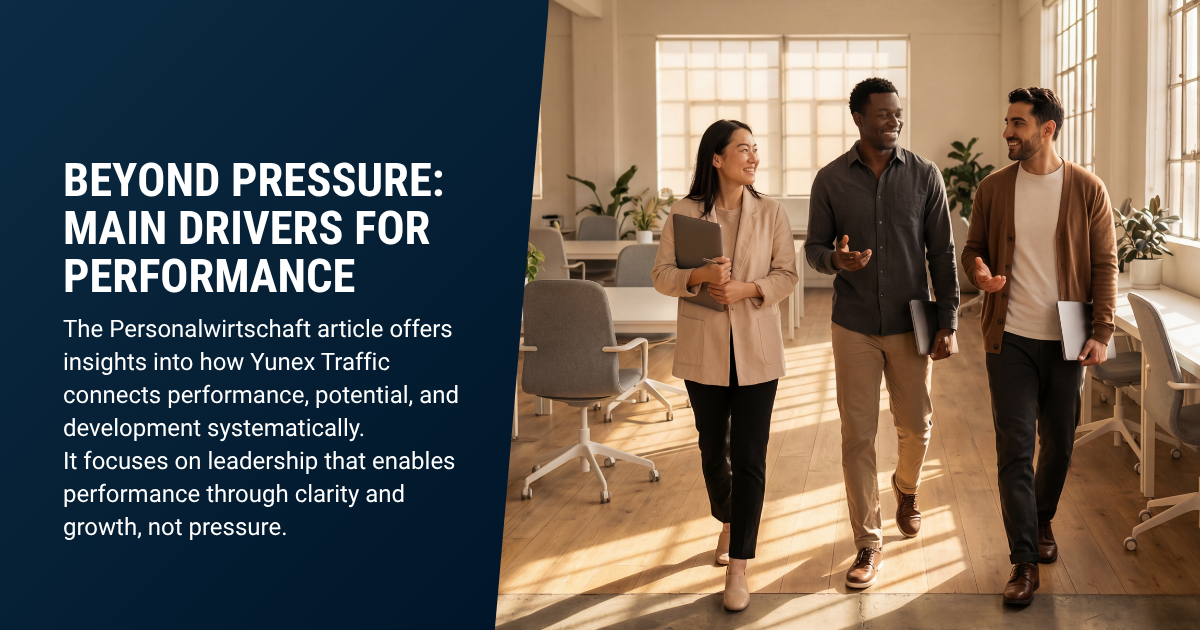
Performance That Grows: Why Performance Doesn’t Come from Pressure
When performance becomes more important, leadership needs to get better.
In many organizations, the pressure is rising to secure productivity, create more transparency around potential, and evaluate performance more effectively. But performance does not come from goals or ratings alone. It emerges when employees have clarity, receive meaningful feedback, and are given real opportunities to grow.
Silvia Hänig’s article in Personalwirtschaft uses the example of Yunex Traffic to show how performance management and leadership training can be meaningfully connected. At the center is one key question: How can leaders be enabled so that goal-setting, feedback, and development conversations do not just take place, but actually create impact in day-to-day work?
Performance That Grows: Why Performance Doesn’t Come from Pressure
Performance is back on the business agenda. Many organizations are currently looking at how they can increase productivity, identify potential more effectively, and evaluate performance more transparently.
That is understandable. At the same time, there is a risk: when performance is only demanded, pressure quickly builds. When it is actively enabled, performance can grow from clarity, motivation, and development — and ideally become something people experience as energizing rather than burdensome.
That is the key difference in a modern performance culture.
Performance is not an isolated state. It does not come from goal-setting systems, ratings, or tighter control alone. It emerges when people understand what is expected of them, receive helpful feedback, and experience development as part of good leadership.
Performance should not become another source of pressure for leaders and teams. It should grow from intrinsic motivation: because people understand what they are working toward, where they can grow, and how their contribution becomes visible.
A strong performance culture is not about simply asking people to do more. It creates the conditions for performance to feel meaningful, achievable, and motivating. That is the difference between demanding performance and enabling it.
Enabling Performance Instead of Just Demanding It
Performance management and leadership are already being connected in many organizations. So the real question is no longer whether the two belong together.
The question is: Do they actually work together in day-to-day practice?
Too often, performance management remains a formal process. Goals are documented, conversations take place, reviews are completed. But the development-oriented impact does not materialize.
This is where the real gap emerges.
When leaders have little time for feedback or goal-setting conversations, when conversations only happen once something goes wrong, or when employees experience performance management mainly as a rating, the process loses its real purpose.
And yet, goal-setting, feedback, and development conversations could deliver exactly what many organizations need right now: orientation, motivation, and visible development.
For that to happen, leaders need to be enabled to hold these conversations in a clear, fair, and effective way.
Yunex Traffic: Growth Talks as Part of Effective Leadership
One practical example is Yunex Traffic.
The company wanted to capture performance, potential, and development opportunities in a more systematic and transparent way. Not because performance was lacking, but because development could be made more targeted.
At the center were Growth Talks and the question of how leaders around the world could be better prepared for goal-setting, feedback, and performance conversations.
To do this, the existing leadership training was closely connected with the performance management process. Around 400 leaders across different countries and time zones are being supported through individual learning journeys designed to strengthen the social and communication skills needed for regular conversations with their teams.
Together with DeepSkill, a learning architecture was developed that is tailored to the needs of leaders during a transformation phase and can be integrated into day-to-day work as seamlessly as possible.
What matters most: these conversations were not treated merely as a process, but as real leadership situations. Leaders were supported in understanding what quality looks like in goal-setting and feedback conversations, how to formulate expectations clearly, and how to respond to employees individually.
That is how performance management moves beyond administration and becomes something leaders can actually bring to life in everyday work.
Why Return on Learning Matters
The Return on Learning perspective is especially relevant here.
Effective leadership development is not about whether a training was well received or completed. What matters is whether behavior changes in everyday work.
Are expectations communicated more clearly?
Are feedback conversations more helpful?
Do employees feel better supported?
Can leaders handle difficult performance situations with greater confidence?
Only when learning creates impact in real leadership situations does it generate true business value.
That is why modern performance culture needs more than processes. It needs learning architectures that make development measurable, applicable, and connected to everyday work.
At Yunex Traffic, this idea is already reflected in the implementation: the learning architecture combines trainings, peer practices, and transfer sessions to not only prepare leaders in theory, but also support them in applying what they have learned in practice.
Because performance should not come from pressure. It should grow through better leadership, clear expectations, and motivating development.
Why It Is Worth Taking a Closer Look
The example of Yunex Traffic shows that performance management and leadership development do not simply belong together. They need to be connected in a way that makes leaders truly more capable in everyday work.
Only then can a culture emerge in which performance is not just evaluated, but actively enabled. A culture in which performance is not experienced as pressure, but as the shared development of people, teams, and the organization.
The article in Personalwirtschaft goes one step further and explains why traditional performance evaluation is reaching its limits in today’s work cultures. Performance no longer depends only on goals or individual discipline. It is also shaped by motivation, skills, working conditions, and the quality of leadership.
That is why the deeper research perspective Silvia Hänig references in the article is worth a closer look: it shows why organizations need to do more than demand performance — they need to actively enable it. And it explains why feedback, goal-setting, and development conversations are such a central lever.
Silvia Hänig’s full article in Personalwirtschaft explores how Yunex Traffic is shaping this journey, what role Growth Talks play, and how leadership training can become a lever for fair performance evaluation.
Read the full article here:
“Leistung richtig bewerten: So kann HR bei der Führung ansetzen” – Personalwirtschaft

Safeguard your organization's performance and retention during strategic transitions.
Let's discuss a customized roadmap for your team.